Judgement has been out a few weeks now, and I’ve been pleasantly surprised by how it’s doing. Nothing earth-shattering — it won’t make any bestseller lists, and I never expected it to. But last week I was out shopping with my wife when she bumped into someone she knew. After a quick exchange of pleasantries, the woman looked at me and said: “So, is this the author?”
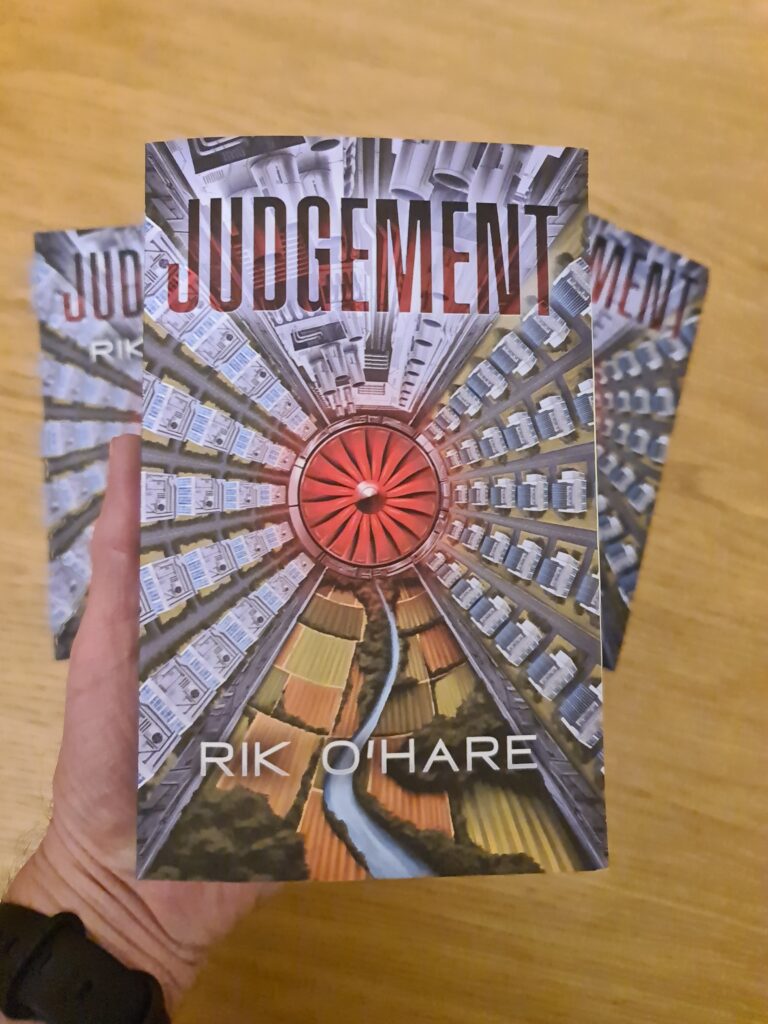
That was quite a moment. Someone I’d never met before knew about my book — from Facebook, no less. And it made me really glad I’d chosen to go the Indie publishing route. So I thought I’d share what prompted that decision, and why I’m so pleased I made it.
When I started writing Judgement, it was simply to see if I could write a coherent novel. As I got closer to the finish, I realised not only that I could, but that it was actually quite good. Feedback from my writing critique group (hello, BSFA Orbit Novel Group 11 👋) was generally positive, and my beta readers felt the same.
So I thought: what’s the next step?
The obvious answer was to try to get published. So I went down the querying route — and learnt why they call it ‘The query trenches’.
I hated the submissive nature of it. I hated carefully tailoring query letters and synopses to individual agents, only to receive no acknowledgement whatsoever. I hated the bog-standard rejection form letter.
I hated. Every. Single. Second.
Then came a genuinely useful rejection — from an agent I won’t name — that gave me pause. They told me to keep trying, citing Iain M. Banks, who spent ten years and five novels before being picked up. I looked in the mirror and thought: do I even have ten years of writing in me? I’m 61 and not particularly marketable.
If an editor is deciding where to allocate finite resources, are they going to choose me or the photogenic twenty-something with a massive TikTok following? I’ll let you guess.
I wouldn’t mind if publishing were a true meritocracy — where the books that get published are simply the best ones (whatever that means). But we know it isn’t. There’s plenty of traditionally published books that I ‘Did Not Finish’ because I didn’t like them. That’s not necessarily because they were bad, but they didn’t work for me. Once you get past the technicalities of writing, it becomes very much about personal taste and opinion. The same goes for agents and editors.
So I asked myself some honest questions.
What did I set out to do? Write a novel. Done. What did I want next? To hold a physical copy of my book in my hands. To look up at my shelves and see a proper, printed copy sitting there. How would I achieve that? Traditional publishing didn’t seem likely to deliver it — and I wasn’t prepared to let strangers decide that something I’d poured so much into would quietly die on my hard drive.
Self-publishing would get me there. Absolutely.
Trad publishing was a barrier; Indie was the way through. Not a fallback or a consolation prize — for me it was the best solution.
I learned how to get the manuscript edited, how to get a cover designed, how to market — not to sell thousands of copies or win awards, but just to get the word out. To shine a little light on something I’m proud of and not let it die in the dark.
And now I have a book out in the real world — and someone in a supermarket called me the author.
Priceless.
If you want to keep up to date with what’s happening in my writing world, and get the first chapter of Judgement for free: sign up to the newsletter.