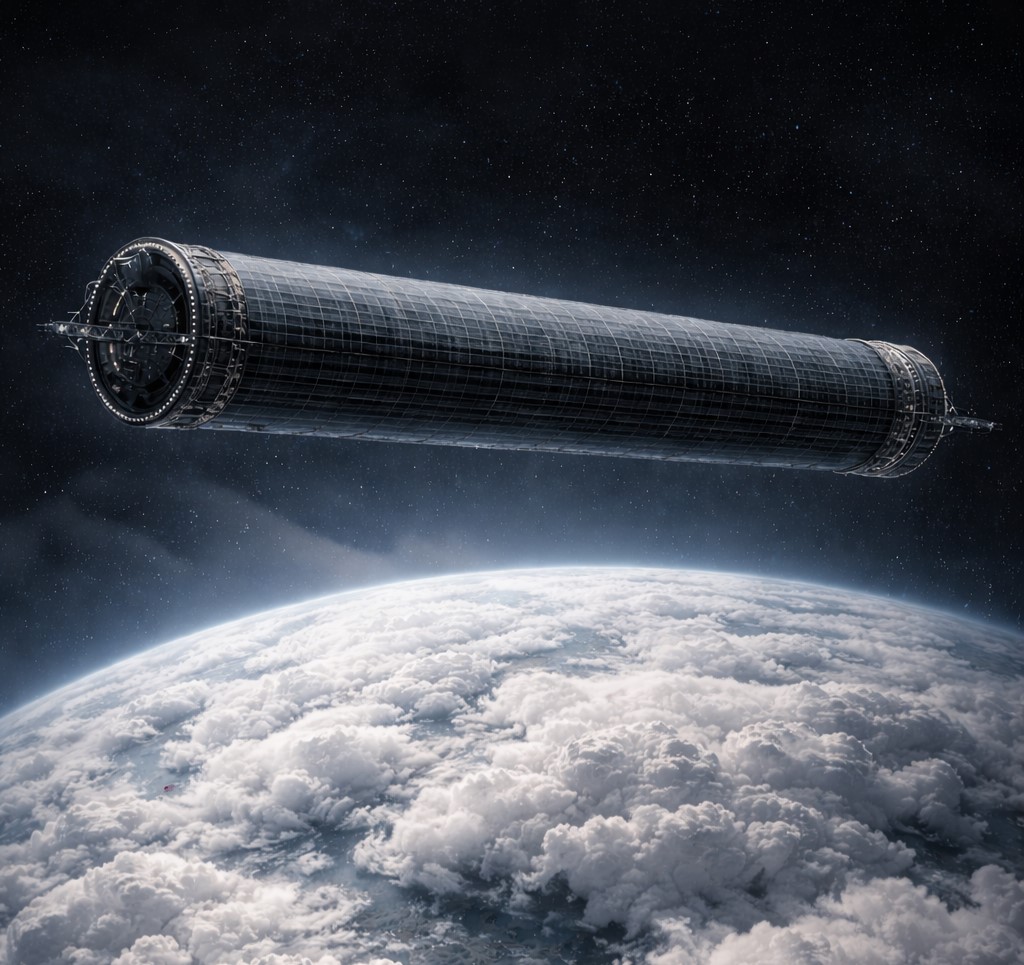
What is an O’Neill Cylinder?
Imagine looking up and seeing a river winding across the sky, green fields curving overhead, and sunlight streaming across streets that stretch for kilometres. Welcome to life inside an O’Neill cylinder – one of the most compelling visions for humanity’s future in space and the setting for my novel Judgement.
In 1976, physicist Gerard K. O’Neill published The High Frontier, a book that asked a deceptively simple question: why colonise planets at all? Planets come with problems – crushing gravity, toxic atmospheres, inconvenient distances from the Sun. O’Neill proposed something different: purpose-built habitats, free-floating in space, designed from the ground up for human life.
His flagship concept was the O’Neill cylinder. I’ve taken the basic idea and tweaked it to fit my world better – the Earth-Like Living Environment or ELLE habitat. Picture a massive cylinder, roughly 2 kilometres in diameter and 18 kilometres long. As the cylinder rotates around its circumference once per minute, it creates artificial gravity along the interior walls, meaning residents would live on the inner surface, looking “up” at the landscape curving above them.
At each ‘end’ of the cylinder is a fusion reactor, called a Sun, delivering heat and light whilst giving the habitat a natural day-night cycle. The land strips would hold soil, vegetation, rivers, and entire towns — a self-contained world with its own weather, agriculture, and ecosystems.
Because the habitat is enclosed and engineered, you can fine-tune the climate, filter the air, and manage resources in ways that are impossible on a planetary surface. No hurricanes unless you want them. No droughts. No seasons, unless you choose to simulate them.
Why It Still Matters
O’Neill’s designs were rooted in 1970s engineering and materials science, yet the core logic holds up remarkably well. Modern materials like carbon fibre composites and advances in closed-loop life support only strengthen the case. The concept has influenced generations of scientists, engineers, and storytellers — from NASA research programmes to the space stations of Interstellar and Gundam.
More importantly, the O’Neill cylinder addresses a fundamental bottleneck in thinking about space settlement. Planetary surfaces offer limited real estate and demand enormous energy to escape their gravity wells. Free-space habitats, built from asteroid-mined materials, could theoretically provide millions of times more living area than Earth — all positioned conveniently near the Sun’s energy.
The Road Ahead
No one is building an O’Neill cylinder tomorrow. The cost, logistics, and sheer scale remain staggering. But each step we take – learning to live on the International Space Station, developing in-space manufacturing, mining near-Earth asteroids – brings the concept a little closer from science fiction to engineering roadmap.
O’Neill’s real legacy isn’t a specific blueprint. It’s a shift in perspective: space isn’t just a place we visit. With enough ingenuity, it’s a place that someone called Martal Strand might call home.
Want to see what life inside an O’Neill cylinder really looks like? Judgement is coming April 2026 — join the newsletter for a free micro-story set aboard ELLE4.